Introduction
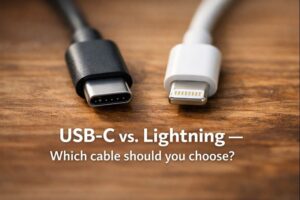
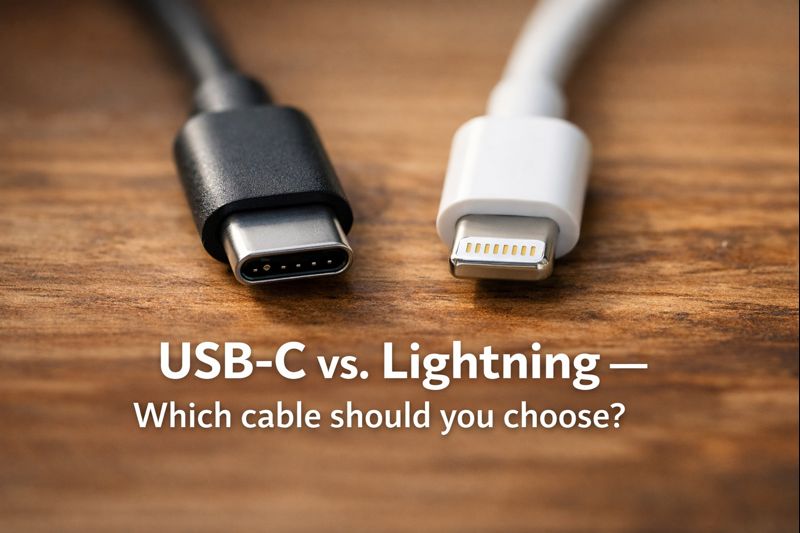
Choosing the right cable for your smartphone isn’t just about plugging it in—it affects charging speed, data transfer, accessory compatibility, and long-term ease of use. In recent years, two major standards have emerged: USB-C and Apple’s Lightning. Whether you’re deciding what to buy for a new phone or considering an accessory upgrade, this article provides technical differences, actual performance, advantages, disadvantages, and a simple buying guide to help you make an informed choice with confidence.
Key SEO keywords: USB-C vs Lightning, USB-C vs Lightning, best cable for phone, phone cable buying guide.
Brief Summary (TL;DR)
- USB-CIt’s the industry standard for Android phones and many USB accessories—it’s versatile, supports high power and fast data rates, and can be reversed.
- lightning This is Apple’s proprietary connector – compact, widely used in iPhone accessories, and still supported on many iPhones (depending on the model/year).
- To meet future challenges and ensure compatibility with various devices, USB-C is used. Generally, Lightning is a better long-term choice; for Apple-centric users with many Lightning accessories, Lightning may still be suitable.
What is USB-C?
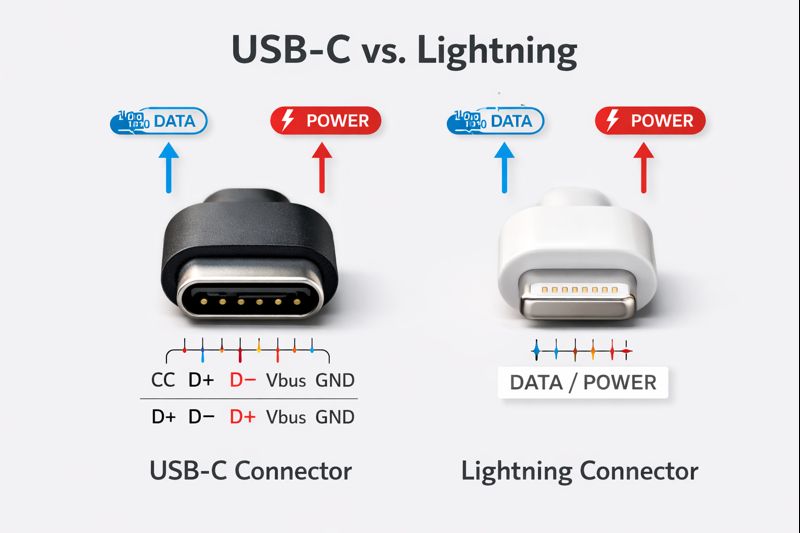
USB-C (or USB Type-C) is a physical connector specification introduced to replace older USB types. It is reversible, supports modern USB standards (USB 3.x, USB4), and most importantly, supports higher power delivery (USB Power Delivery, or PD) and faster data transfer rates, depending on the cable and device.
Main advantages: Reversible plug, can be used with multiple devices (phones, laptops, tablets), supports PD for fast charging, and can transfer high-speed data and video.
What is electricity?
Lightning is Apple’s exclusive connector, introduced in 2012 to replace the 30-pin dock connector on iPhones and iPads. It’s a smaller, multi-pin connector optimized for Apple’s devices and ecosystem. Apple is moving many of its devices to USB-C (especially iPads and Macs), but Lightning is still present in some iPhone models (depending on launch year and regional regulations).
Main advantages: Compact design, extensive accessory ecosystem (MFi certified), optimized for Apple devices.
Technical comparison table
| Speciality | USB-C | lightning |
| started | 2014 (Type-C connector) | 2012 |
| Reversible Plug | Yes | Yes |
| Typical Maximum Power (with PD) | Up to 240W (USB PD Extended; phones typically 18–100W) | Older iPhones typically require ~12–20W (but adapter limitations apply) |
| Maximum data speed | USB 2.0 — 480 Mbps; USB 3.2/USB4 — up to 40 Gbps (device dependent) | Lightning’s maximum speed on many devices is around 480 Mbps (USB 2.0 speed). |
| Video Support | Yes (with alternate mode) | There are no native alternate video modes; these require an adapter. |
| Ecosystem | Wide range of Android phones, laptops, peripherals | Apple ecosystem, MFi accessories |
| Being prepared for the future | High (industry-wide acceptance) | Low — Proprietary, Apple is switching to USB-C on some devices |
| Cost (cables/accessories) | Wide range of prices; many affordable options | The price is a bit high for certified MFi accessories. |
Differences that matter in the real world
Charging speed and power supply
USB-C + USB Power Delivery (PD) provides variable voltage and current, enabling very fast charging on compatible phones (for example, 20W, 30W, 65W). Lightning charging speed depends on the iPhone’s charging circuit and adapter; recent iPhones can fast-charge via Lightning using a USB-C to Lightning cable and a USB-C PD adapter, but the Lightning connector has its limitations compared to the top-of-the-line USB-C PD setup.
Data Transfer and Backup
If you frequently transfer large files (4K videos, backups), USB-C cables that support USB 3.x or Thunderbolt will be much faster than standard Lightning connections. This is important for creators or anyone who transfers large files between their phone and PC.
Ecosystem and Accessories
Lightning is a great option for those invested in Apple-specific accessories (docks, older car integration, older headphones.) USB-C is now everywhere – you can charge your phone, laptop, power bank, and many other devices with a single cable.
Durability and Convenience
Both connectors are reversible and robust in modern devices. The quality of USB-C cables varies widely; buy reputable and certified cables. Lightning cables are usually MFi certified for compatibility with Apple (look for the MFi badge on the packaging).
Advantages and disadvantages (briefly)
USB-C
Pros
- Compatibility with different platforms (phone, laptop, tablet).
- It supports fast charging (USB PD) and high data speeds (USB 3.x/USB4).
- Ready for the future — Its use in the industry is increasing.
Shortcoming - Cable quality varies widely; ensuring PD/data support is essential.
- Older accessories (for Lightning users) are incompatible without an adapter.
lightning
Pros
- There is a wide selection of accessories available in the Apple ecosystem.
- Compact and reliable connector for multiple iPhones.
Shortcoming - Being proprietary, it has limited usage across different devices.
- Usually, the maximum data rate is lower than USB-C versions.
- Apple is transitioning its product line to USB-C (regional regulations are speeding up this process).
How to Choose the Right Cable
- Check your device port
- If your phone has a USB-C port → buy a USB-C cable (USB-C to USB-C cable for PD charging).
- If it has a Lightning port, buy one with a USB-A to Lightning or USB-C to Lightning port, depending on your charger.
- Matchbox charging required
- For faster charging, get a cable and power adapter that supports USB Power Delivery (PD). For example: USB-C to USB-C cable + PD adapter (for faster phone charging at 30W or higher).
- Does data speed matter?
- If you transfer large files, buy a data-capable cable (look for the USB 3.1/3.2 or Thunderbolt label). Many cheap cables only support charging.
- Buy Certified Accessories
- For electricity: see MFIs Certification. For USB-C: Choose a reputable brand and check the specifications (PD, USB 3.x, braided vs. rubberized).
- Length and texture
- Choose the length that suits your needs (0.5–1 meter for pocket/desk use; 2–3 meters for sofa/bed use). Woven cables are generally more durable; reinforced strain relief is an added benefit.
- Being prepared for the future
- If you plan to use the same cable across different devices (phone, tablet, laptop), USB-C is the safest option.
Recommended situations (when to buy which product)
- You have an Android phone, a recent iPad, or a laptop: USB-C is a practical option.
- You’re deeply ingrained in Apple’s Lightning accessory ecosystem and don’t plan on changing devices in the near future: Keep Lightning, but consider adding a USB-C charger and USB-C to Lightning cable for faster charging.
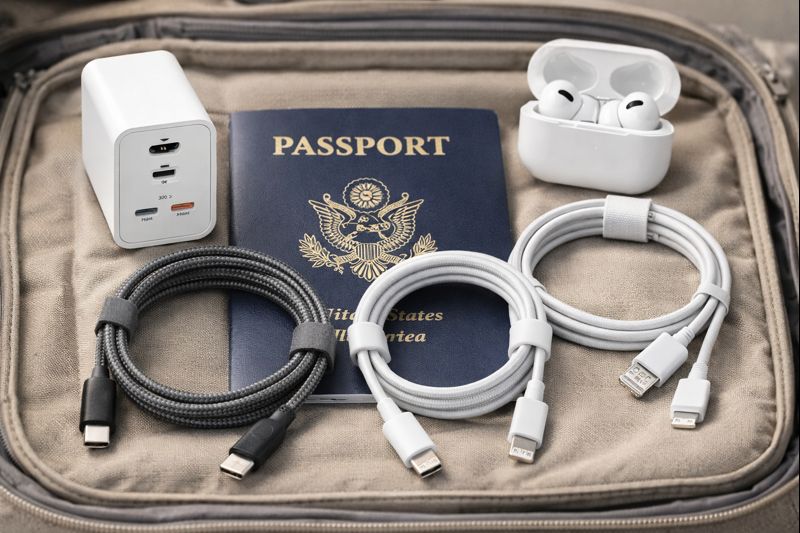
- All you need is a single cable for travel: Buy a high-quality USB-C cable and a multi-port USB-C PD charger.
Quick Shopping Checklist
| need | If you want to choose USB-C then… | If you choose Lightning then… |
| One cable for all devices | You have a laptop/tablet/Android phone | All you have is an old iPhone and a bunch of Lightning accessories. |
| Fast charging | Need PD fast charging and higher wattage? | Your iPhone supports fast charging with a USB-C to Lightning cable, but it will require a PD adapter. |
| Faster file transfer | You need USB 3.x/Thunderbolt speeds. | Transfers are occasional and small. |
| stuff | You love cross-device hubs, docks, and monitors. | needed |
questions to ask
Can I use a USB-C to Lightning cable for fast charging?
Yes—with a compatible USB-C PD adapter and supported iPhone model, the USB-C to Lightning cable enables fast charging on many iPhones.
Is USB-C fit for the future?
Far more so than Lightning. The industry is standardizing USB-C; many regulators (and manufacturers) are moving toward a single-port standard.
Will Apple switch all iPhones to USB-C?
Apple is migrating many devices to USB-C. Regardless of the product roadmap, USB-C’s growing popularity across the industry makes it a safe choice for future compatibility
conclusion
If you are aiming for convenient use on different devices and being future-ready,USB-CIt’s a practical option. If your life revolves around older Apple accessories and you don’t plan on replacing hardware anytime soon,lightningIt still works well. The best approach for many users is a mixed setup: keep a must-have Lightning cable for older devices, and use USB-C for newer chargers, power banks, and any devices that benefit from faster charging or data speeds.