Introduction: Why Wireless Charging Matters More Than Ever
Let’s be honest—cables are annoying. They fray, they tangle, and they always seem to disappear right when your phone hits 3%. In 2024, wireless charging isn’t just a luxury anymore; it’s part of everyday life. Whether it’s on your office desk, bedside table, or in your car, dropping your phone on a pad and watching it charge feels… well, kind of magical.
But here’s the big question: should you go with MagSafe or Qi? If you’ve been shopping for a wireless charger lately, you’ve probably seen both terms everywhere. They sound similar, but they’re not the same thing.
Today, we’re going to break it all down in plain English. No tech jargon overload. Just a clear, honest, real-world comparison of MagSafe vs Qi in 2024 so you can decide what’s actually worth your money.
What Is Wireless Charging? A Quick Refresher
Wireless charging uses electromagnetic induction to transfer power from a charging pad to your phone—no cable plugged into your phone needed. The charger creates a magnetic field, your phone receives it, and boom—energy flows.
It’s not truly “wireless” (the charger still needs a cable), but from a user perspective, it feels like it. You just drop and charge.
Now, let’s meet the two main players: Qi and MagSafe.
Understanding Qi Charging Standard
[Image Prompt: A variety of Android and iPhone devices charging on different Qi wireless pads on a table]
What Is Qi and How It Works
Qi (pronounced “chee”) is the global standard for wireless charging. It’s developed by the Wireless Power Consortium and is supported by almost every major smartphone brand—Apple, Samsung, Google, Xiaomi, and more.
If you’ve ever used a generic wireless charging pad from Amazon or a café, chances are it was Qi.
Evolution of Qi: From 5W to 15W and Beyond
In the early days, Qi charging was painfully slow—5W felt like watching paint dry. But in 2024, most modern Qi chargers support 10W to 15W, and Qi2 (the newer standard inspired by MagSafe) is starting to roll out with magnetic alignment and better efficiency.
Devices That Support Qi in 2024
- iPhone 8 and newer
- Samsung Galaxy S series
- Google Pixel series
- Most modern Android flagships and mid-range phones
- Wireless earbuds, smartwatches, and even some accessories
Pros of Qi Charging
- ✅ Works with almost every phone
- ✅ Huge variety of chargers and price options
- ✅ Affordable
- ✅ No brand lock-in
Cons of Qi Charging
- ❌ Slower than MagSafe for iPhones
- ❌ Alignment can be finicky
- ❌ Less efficient (more heat, more energy loss)
Understanding MagSafe Technology
[Image Prompt: Close-up of an iPhone snapping magnetically onto a MagSafe charger, visible magnetic ring, minimal background]
What Is MagSafe and How It Works
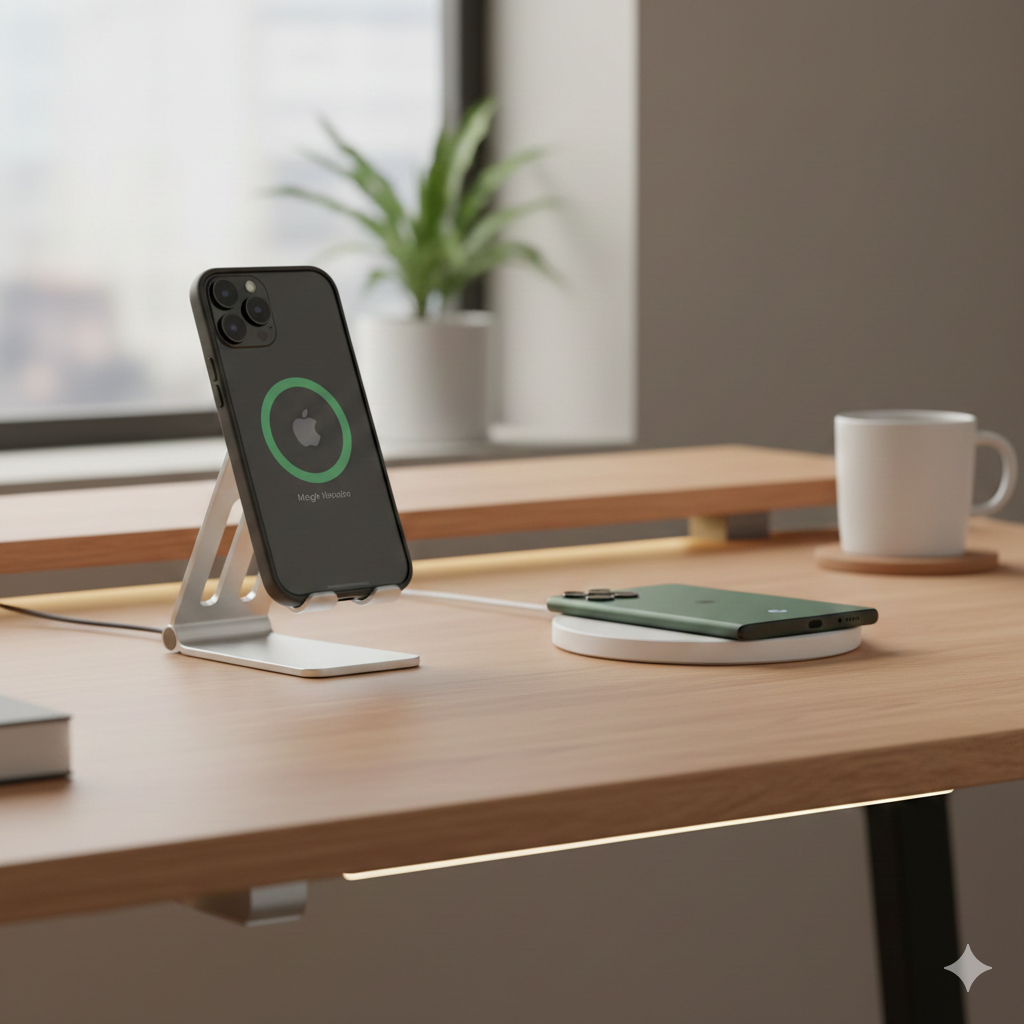
MagSafe is Apple’s enhanced wireless charging system. It’s basically Qi + magnets + Apple magic.
A ring of magnets inside the iPhone perfectly aligns the charger every time. No more “is it actually charging?” moments.
Why Apple Created MagSafe
Apple wanted:
- Faster wireless charging
- Better alignment
- More accessories (wallets, stands, car mounts)
And honestly? They nailed it.
Devices That Support MagSafe in 2024
- iPhone 12, 13, 14, 15, and 16 series
- Some AirPods cases
- MagSafe accessories (battery packs, wallets, stands)
Pros of MagSafe Charging
- ✅ Perfect alignment every time
- ✅ Faster charging (up to 15W for iPhones)
- ✅ More efficient and less heat
- ✅ Strong accessory ecosystem
Cons of MagSafe Charging
- ❌ More expensive
- ❌ Mostly limited to Apple devices
- ❌ Cheaper “MagSafe-compatible” chargers may not give full speed
MagSafe vs Qi: Core Differences Explained
Charging Speed Comparison
- MagSafe: Up to 15W on iPhones
- Qi: Usually 7.5W on iPhones, 10–15W on Android
For iPhone users, MagSafe is clearly faster.
Alignment and Efficiency
MagSafe wins here. The magnets snap the charger into the perfect position every time. Qi? You still have to nudge it around like a sleepy alarm clock.
Compatibility and Ecosystem
Qi is universal. MagSafe is mostly Apple-only.
Heat Management and Battery Health
Better alignment = less wasted energy = less heat. MagSafe generally runs cooler and more efficiently.
Price and Availability
Qi chargers are cheaper and everywhere. MagSafe accessories usually cost more.
Comparison Table: MagSafe vs Qi in 2024
| Feature | MagSafe | Qi |
|---|---|---|
| Compatibility | Mostly Apple | Almost all phones |
| Max Speed | 15W (iPhone) | 7.5W (iPhone), up to 15W (Android) |
| Alignment | Magnetic, perfect | Manual |
| Efficiency | High | Medium |
| Heat | Less | More |
| Price | Higher | Lower |
| Accessory Ecosystem | Excellent | Basic |
Real-World Use Cases: Which One Fits Your Life?
For iPhone Users
If you’re using an iPhone 12 or newer, MagSafe is a no-brainer. Faster, easier, cleaner.
For Android Users
Stick with Qi. MagSafe doesn’t offer much value here unless your phone supports Qi2 with magnets.
For Multi-Device Households
Qi chargers make more sense. One pad, many devices.
For Car and Desk Setups
MagSafe car mounts are amazing. The phone just clicks into place like it belongs there.
Buying Guide: How to Choose the Right Wireless Charger
What to Check Before Buying
- Your phone model
- Maximum supported wattage
- Case compatibility
Certifications and Safety
Look for:
- Qi certification
- Apple-certified MagSafe (for full 15W speed)
Wattage, Adapters, and Cables
Many chargers don’t include adapters. A weak adapter = slow charging.
Stands vs Pads vs Multi-Chargers
- Pads: Cheap, simple
- Stands: Great for desks
- Multi-chargers: Perfect for phone + watch + earbuds
Future of Wireless Charging: What’s Coming Next?
Qi2 is bringing magnetic alignment to the Android world. Apple is also working on portless iPhones. The future? Even fewer cables. Even more convenience.
Conclusion
So, MagSafe vs Qi in 2024—who wins?
- If you’re an iPhone user, MagSafe is absolutely worth it.
- If you use Android or multiple devices, Qi is still the king of compatibility.
Think of it like this:
MagSafe is a luxury express train. Qi is the reliable public transport system. Both get you there—just in different styles.